
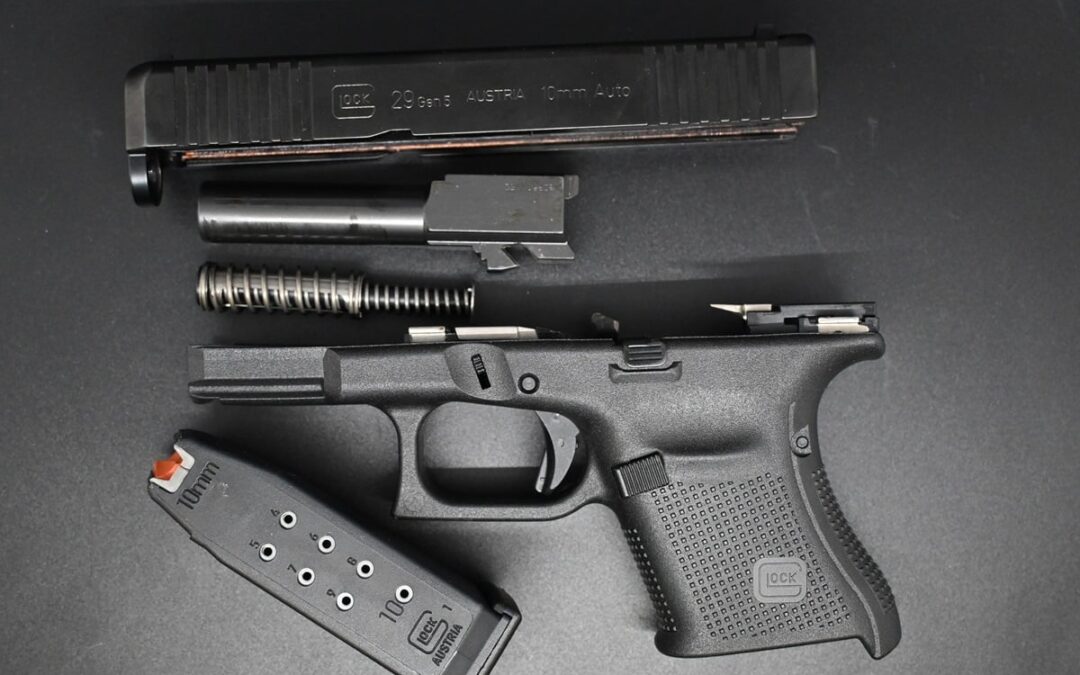
Glock 29 Gen 5 Review: A Detailed Look at Glock’s Compact 10mm
The Glock 29 has always occupied an unusual position in Glock’s lineup. It is substantially smaller than the company’s full-size 10mm pistols, yet it retains the same 10mm Auto chambering. That combination has helped the G29 maintain a dedicated following since its introduction in the 1990s. The arrival of the Glock 29 Gen 5 brings several of Glock’s more recent design changes to the compact platform. While the overall concept remains familiar, the latest generation introduces updates to the grip, slide, finish, controls, and barrel.
After more than 500 rounds of testing, the Gen 5 version provides an interesting look at how a long-running compact 10mm design has evolved.
Table of Contents
- Glock 29 Gen 5 Overview
- What’s New With the Glock 29 Gen 5?
- Glock 29 Gen 5 Specifications
- Glock 29 Gen 5 Trigger Performance
- Glock 29 Gen 5 Reliability Testing
- Glock 29 Gen 5 Accuracy and Range Performance
- Glock 29 Gen 5 Ergonomics and Handling
- Glock 29 Gen 5 Advantages and Limitations
- Frequently Asked Questions
- Final Verdict
Glock 29 Gen 5 Overview
The original Glock 29 appeared in 1996, giving shooters a factory-produced compact option in 10mm Auto at a time when the caliber had relatively few compact platforms available. The Gen 4 G29 arrived in 2013, bringing the model into Glock’s fourth-generation family. The Gen 5 version represents the next significant update, incorporating several features that had already appeared on other Gen 5 Glock pistols. The timing is noteworthy because Glock gradually expanded its Gen 5 treatment beyond its larger and more popular models. The compact G29, along with the .45 ACP G30, became part of that broader transition.
At first glance, the G29 Gen 5 still looks unmistakably like a Glock. The familiar polymer frame, squared-off slide, simple controls, and compact proportions remain. However, several details distinguish it from the earlier-generation design. Among the more visible changes are the removal of the molded finger grooves and the addition of front slide serrations. The pistol also incorporates an nDLC finish, an ambidextrous slide stop lever, and an updated Glock Marksman Barrel. These aren’t changes that completely reinvent the G29. Instead, they represent a collection of incremental improvements intended to bring the compact pistol into line with the broader Gen 5 family.
Glock 29 Gen 5 Review | Brand New Glock 29 Gen 5 For Sale
What’s New With the Glock 29 Gen 5?
Glock made approximately 20 changes when moving from the previous-generation design to the Gen 5 configuration. Not every change is immediately obvious, but several are particularly relevant to shooters.
Finger-Groove-Free Grip
Earlier Glock generations used molded finger grooves on the front of the grip. The Gen 5 design removes those grooves and replaces them with a straighter profile.
The result is a simpler grip shape that allows the shooter’s fingers to find their own natural position rather than being guided by molded contours.
Front Slide Serrations
The addition of front serrations gives the shooter another area for manipulating the slide.
The rear serrations remain, but the additional forward gripping surface provides more flexibility in how the slide can be handled.
nDLC Finish
The Gen 5 G29 also receives Glock’s nDLC finish. The finish is part of the visual and functional update associated with the fifth-generation design.
Ambidextrous Slide Stop Lever
The slide stop lever is configured for use from either side, another characteristic shared with other Gen 5 Glock models.
Glock Marksman Barrel
The G29 Gen 5 uses Glock’s enhanced Marksman Barrel. This is another change intended to modernize the platform while retaining the basic architecture that has defined the G29 for years.
Glock 29 Gen 5 Specifications
The primary dimensions and weights recorded during the evaluation were:
| Specification | Measurement |
|---|---|
| Overall length | 6.85 inches |
| Barrel length | 3.78 inches |
| Overall width | 1.38 inches |
| Slide width | Approximately 1.11 inches |
| Overall height | 4.45 inches |
| Standard magazine | 10 rounds |
| Loaded capacity | 10+1 |
| Empty weight with magazine | 26.81 ounces |
| Loaded test weight | 33.6 ounces |
The loaded weight was measured using 10 rounds of 200-grain Federal Punch 10mm ammunition. These measurements put the G29 firmly in the compact category while also illustrating one of the central characteristics of the pistol: it is relatively small for a 10mm, but it is not particularly thin. The dimensions make more sense when considered alongside the cartridge. The 10mm Auto is a substantially larger cartridge than the 9mm ammunition commonly associated with modern compact handguns.
Glock 29 Gen 5 Trigger
The Gen 5 G29 uses Glock’s standard fifth-generation trigger system.
During initial testing, the trigger broke at an average of approximately 5.6 pounds. The take-up before reaching the wall was relatively short, and the trigger exhibited the familiar characteristics associated with Glock’s striker-fired system.
One of the more noticeable aspects of the trigger was its reset. The reset measured approximately 0.26 inches and was both audible and tactile. That made the reset relatively easy to recognize during repeated shooting. The consistency was also notable. Individual trigger presses felt substantially similar rather than producing large variations from one shot to the next. After approximately 500 rounds, the trigger was measured again. The average pull weight had moved to approximately 5.3 pounds. That small difference is unlikely to be significant in ordinary shooting and suggests that the trigger remained consistent throughout the evaluation.
Glock 29 Gen 5 Reliability Testing
Reliability was one of the strongest aspects of the test.
More than 500 rounds of factory-loaded, SAAMI-specification 10mm ammunition were fired through the evaluation pistol.
The result was straightforward: there were no malfunctions during the testing session.
Approximately 350 rounds consisted primarily of CCI Blazer Brass 180-grain FMJ ammunition, listed at approximately 1,200 feet per second. Additional Winchester Target & Practice 180-grain FMJ ammunition was also used. The evaluation also included approximately 160 rounds of defensive ammunition, most of which consisted of Federal Personal Defense Punch 200-grain JHP ammunition with an advertised velocity of approximately 1,100 feet per second. The pistol continued to function normally with those loads. The barrel is also almost fully supported. Although every fired case was not individually inspected, no visibly bulged cases were observed during the testing process.
As with any individual firearm evaluation, the results apply specifically to the pistol and ammunition used during testing. A successful test does not guarantee identical performance from every example under every ammunition combination.
Glock 29 Gen 5 Accuracy
The compact dimensions of the G29 create some interesting challenges when shooting for precision.
The pistol combines a short grip, a compact sight radius, the standard Glock trigger, and the recoil characteristics of 10mm Auto. Those factors can become increasingly noticeable as shooting distances increase. One observation from the range was that maintaining a completely consistent grip during rapid strings could be difficult. Because the grip is relatively short, there isn’t a great deal of space beneath the shooter’s hand. During rapid fire, the pistol could move slightly in the hand, resulting in vertical strings within groups.
That characteristic becomes more apparent as distance increases.
At 25 yards, however, the pistol remained capable of producing center-mass hits with deliberate shooting and concentration. The factory sight arrangement also influences the shooting experience. Some shooters may find the traditional Glock sight configuration perfectly serviceable, while others may prefer a different sighting system. An optics-ready configuration would also provide another option for shooters who favor miniature red-dot sights. The compact dimensions of the G29 make the subject particularly interesting because an appropriate optic could potentially make target acquisition and aiming easier for some users.
Glock 29 Gen 5 Ergonomics and Handling
The Gen 5 grip design is one of the easiest differences to identify compared with earlier G29 generations.
Removing the finger grooves produces a flatter, more neutral grip profile. Whether that is an improvement depends partly on the shooter’s hand size and preferred grip style, but it does make the frame feel less prescriptive. The short grip remains an important part of the pistol’s character. That compact grip helps keep the overall dimensions down, but it also means that larger hands may have less surface area available for a full firing grip. This is one of the unavoidable compromises involved in building a compact pistol around the relatively large 10mm Auto cartridge.
The pistol’s thickness is another consideration. Compared with many modern compact 9mm designs, the G29 has a noticeably substantial profile. That additional bulk is not necessarily surprising. The frame and slide must accommodate the larger cartridge, and the pistol has to manage the forces generated by the 10mm cartridge. In other words, the G29’s dimensions are best understood as the result of balancing cartridge size, mechanical strength, capacity, and compactness.
Glock 29 Gen 5 Magazine Compatibility
The standard G29 magazine holds 10 rounds, allowing the pistol to be loaded with 10 rounds in the magazine and one additional round in the chamber.
One of the useful aspects of Glock’s platform is its compatibility across related models. The G29 can also use larger G20 magazines. The larger magazines extend below the compact frame and therefore change the overall grip profile. Their compatibility nevertheless adds flexibility to the platform and reflects the parts commonality that has long been associated with Glock’s pistol lineup. The G29 Gen 5 shares various smaller components with other Gen 5 models, including the larger G20. That commonality is one reason Glock pistols have developed such extensive aftermarket ecosystems over the years.
Glock 29 Gen 5 Pros and Cons
Advantages
Compact dimensions:
The G29 remains unusually small considering that it is chambered in 10mm Auto.
10mm Auto chambering:
The pistol provides a compact platform for a cartridge known for its substantial performance characteristics.
10+1 capacity:
The standard magazine provides a 10-round capacity, with one additional round possible in the chamber.
Strong reliability during testing:
The evaluation pistol completed more than 500 rounds without a malfunction.
Gen 5 improvements:
The updated grip, front slide serrations, nDLC finish, ambidextrous slide stop, and Marksman Barrel bring the design in line with Glock’s modernized lineup.
Magazine compatibility:
Compatibility with larger G20 magazines adds versatility to the platform.
Limitations
Relatively thick profile:
The G29 is compact but not especially slim.
Short grip:
The compact grip can make maintaining a consistent hold more difficult during rapid fire, particularly for shooters with larger hands.
Traditional sight configuration:
The standard setup may not appeal to shooters accustomed to modern optics-ready compact pistols.
Noticeable recoil:
The combination of a compact frame and 10mm Auto cartridge produces a shooting experience that is substantially different from smaller-caliber compact handguns.
Frequently Asked Questions
What caliber is the Glock 29 Gen 5?
The Glock 29 Gen 5 is chambered in 10mm Auto.
How many rounds does the Glock 29 Gen 5 hold?
Its standard flush-fit magazine has a 10-round capacity, allowing a 10+1 configuration when one additional round is chambered.
How long is the Glock 29 Gen 5?
The overall length is approximately 6.85 inches, with a barrel length of approximately 3.78 inches.
How much does the Glock 29 Gen 5 weigh?
With an empty magazine, the tested pistol weighed approximately 26.81 ounces. With 10+1 rounds of the ammunition used during testing, it weighed approximately 33.6 ounces.
Does the Gen 5 G29 have front slide serrations?
Yes. Front slide serrations are one of the visible changes introduced with the Gen 5 configuration.
Does the Glock 29 Gen 5 have finger grooves?
No. The Gen 5 frame removes the molded finger grooves used on earlier generations.
Can the G29 use G20 magazines?
Yes. The G29 platform is compatible with larger G20 magazines.
How did the G29 Gen 5 perform during reliability testing?
The evaluation pistol fired more than 500 rounds of factory-loaded 10mm ammunition without a malfunction during the reported testing.
Is the Glock 29 Gen 5 significantly different from the earlier G29?
The basic design remains familiar, but the Gen 5 version incorporates numerous updates, including the groove-free grip, front slide serrations, nDLC finish, ambidextrous slide stop lever, and Glock Marksman Barrel.
Conclusions
The Glock 29 is a good example of a handgun design that has remained relevant through several generations. The original model arrived in 1996, and nearly three decades later the basic concept is still recognizable. What has changed is the refinement surrounding that concept. The Glock 29 Gen 5 brings the compact 10mm into Glock’s current-generation design language without losing the characteristics that made the original model distinctive. The removal of the finger grooves gives the frame a cleaner profile. Front slide serrations add another useful feature to the slide. The nDLC finish, ambidextrous slide stop, and Glock Marksman Barrel further align the pistol with other Gen 5 models. The 500-plus-round evaluation also produced a strong reliability result, with no malfunctions observed during the test.
At the same time, the G29 remains a compromise by design. A compact 10mm cannot have the same handling characteristics as a larger handgun chambered in the same cartridge. The short grip, relatively thick frame, and noticeable recoil are all part of the equation. Those characteristics don’t necessarily make the design unsuccessful. Instead, they demonstrate the challenge Glock has been balancing since the G29 first appeared: keeping a powerful 10mm platform small enough to remain genuinely compact. After several generations, the G29 Gen 5 still occupies a distinctive place in Glock’s lineup. It isn’t simply a smaller version of the company’s larger 10mm pistols. It is a specialized compact design that has been incrementally refined over decades.
For a long-running platform, that continuity is arguably one of its most interesting qualities. The G29 began as a relatively unusual compact 10mm nearly 30 years ago. The Gen 5 version shows that the concept still has a place in today’s handgun market, even as the broader industry continues to move toward increasingly small, feature-rich pistol designs.